
stacker® &mallet® laying guide
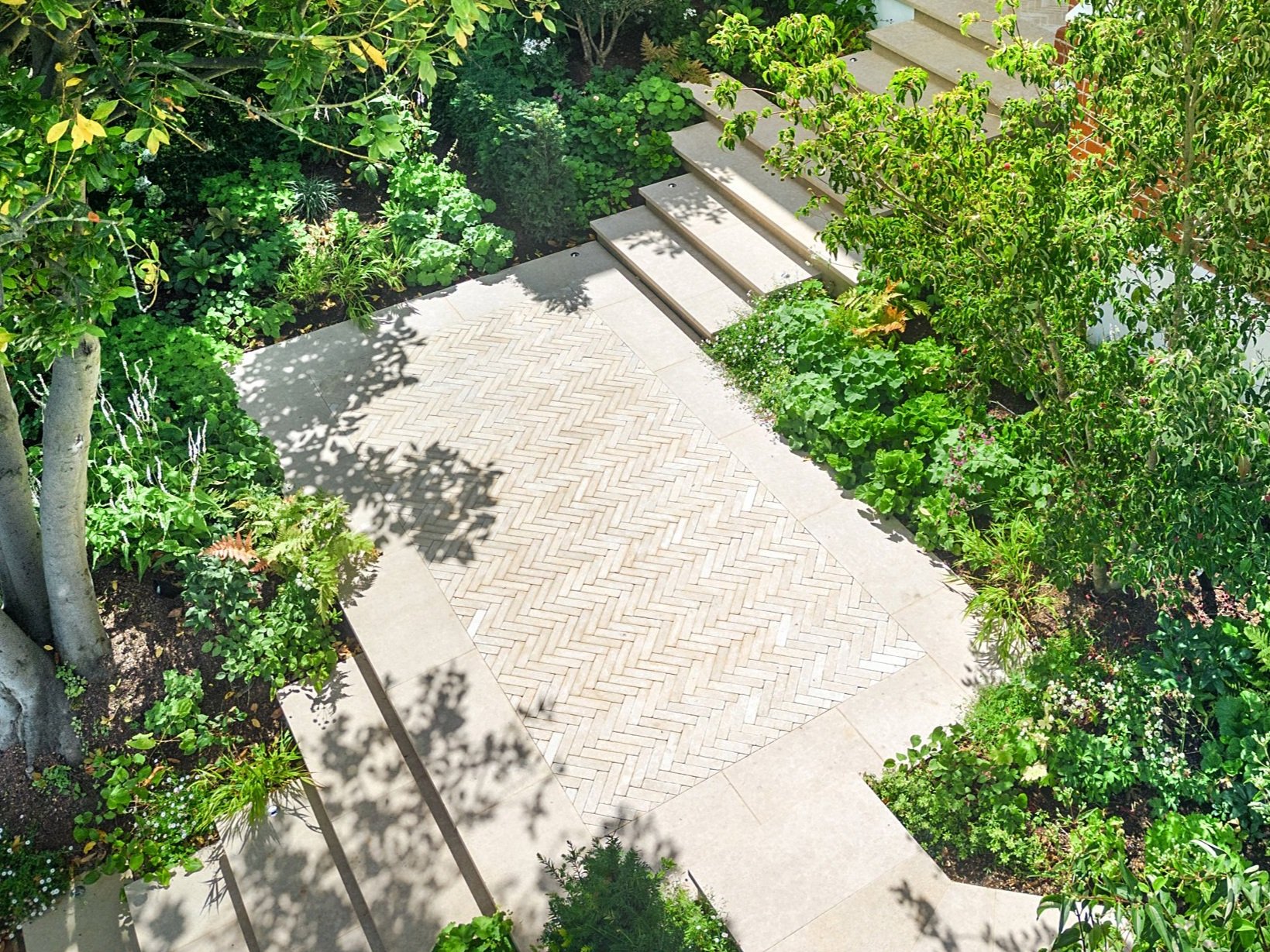
NATURAL STONE STACKERS® & mallets® LAYING GUIDE
Stackers® can be installed on a bedding layer of compacted coarse sand or a cement-based screed if a greater load-bearing capacity is required. Natural stone paving should be installed in accordance to specific instructions that must be followed in order to make sure it will function properly.
Please note: the following information is provided as general guidance only. Each project is unique, and site-specific conditions may require alternative methods or specifications. A detailed site survey and consultation with qualified professionals should always be undertaken before installation. Allgreen cannot be held responsible for the final installation or performance of the product once installed.
Traffic Categories and Paving Thickness
The structural integrity and performance of natural stone paving are directly related to its thickness and the intended traffic load. Allgreen's products are designed for specific applications, and it is critical to select the correct product and construction method for your project's traffic category.
Stackers® (50x200x40mm)
At 40mm thick, are manufactured for pedestrian and light residential vehicular use.
· Traffic Category 1 (Pedestrian Use Only): Stackers are ideal for terraces, footpaths, and garden features, providing a durable and aesthetically pleasing finish.
· Traffic Category 2 (Domestic Driveways): Stackers are suitable for domestic driveways and small car parks subject to car, light van, and motorcycle access. The installation must be a rigid, bound construction in line with British Standard BS 7533-101 recommendations for vehicular traffic.
Traffic Category 3 (Limited Delivery Vehicle Access): Stackers are also suitable for this category, but a rigid, bound construction is mandatory in line with British Standard BS 7533-101 recommendations for vehicular traffic.
Important: Due to their thickness, Stackers at 40mm thick are not suitable for commercial applications or areas with regular use by vehicles over 3,500kg. For projects falling into Traffic Category 4 (Light commercial use) or higher, a thicker, more robust paving solution is required.
Mallets® (70x400x30mm)
Mallets® are designed for use as domestic paving and are an excellent choice for pedestrian areas, such as footpaths and patios. Their 30mm thickness provides exceptional strength and durability for these applications, exceeding the requirements of Traffic Category 1 and in line with industry standards.
Important: Mallets are not suitable for vehicular traffic of any kind (including domestic driveways). Their design is not intended for the concentrated point loads imposed by vehicles. For areas subject to vehicular traffic, please choose a thicker, purpose-designed product which can be supplied made to order or other products such as Cobbles or Setts.
Creating the base
Stackers® & Mallets® are usually installed on a sand & cement screed base however for pedestrian traffic a coarse sand base is sufficient. The quality of the screed and sand base largely determines the quality of the final result. Base build up requirements depend of the kind of traffic the paving will be exposed to, the existing ground conditions and the drainage requirements. As such, a garden path will have different base requirements to a driveway, where the sand will fulfil a load-bearing capacity. In the case of a driveway, the concrete base and sand & cement screed base should transfer and spread the traffic load to deeper layers.
An edge course is required for both pedestrian and vehicular applications which should be laid onto a cement screed bed which should be solidly haunched with a strong sand & cement at a depth of at least 75mm thick.
Traffic Category 1 – Pedestrian Traffic ONLY
Virtually non-load-bearing paving. The required base layer can be either a flexible or rigid construction, with a build-up as follows:
· Sub-base: A structural membrane on top of the soil subgrade. A minimum 100mm compacted MOT Type 1 layer levelled and compacted to match the required surface profile of the paving.
· Laying Course: A 40-75mm layer of coarse sand or a wet sand and cement screed laying course of 50mm or more. A mortar comprising 1:4 Portland cement-aggregate (proportions by volume) is typically used for a rigid base.
When laying a bound construction with sand & cement screed, primer will always be necessary between the stone sett or paving and laying course to provide a sufficient bond.
Traffic Category 2 – Pedestrian and cycle areas, Domestic driveways, Small car parks subject to car, light van and motorcycle access
Paving with very little freight traffic and mainly domestic vehicles up to 3500kg. The required base layer should consist of a full mortar bed with a build-up as follows:
· Sub-base: A structural membrane on top of the soil subgrade. An MOT Type 1 layer of 150mm or more, depending on the soil substrate, levelled and compacted to match the required surface profile of the paving.
· Base: A minimum of 150mm concrete base layer.
· Laying Course: A sand and cement wet screed laying course of 40mm or more.
Primer will always be necessary between the Stacker® or Mallet® and laying course to provide a sufficient bond.
Traffic Category 3 – Domestic Driveways with Limited Delivery Vehicle Access
Paving with very little freight traffic and mainly domestic vehicles up to 3500kg, with the occasional access of a heavier vehicle. The required base layer should be a full mortar bed with a build-up as follows
· Sub-base: A structural membrane on top of the soil subgrade. The MOT Type 1 layer should be a minimum of 275mm thick (depending on soil conditions) and be leveled and compacted to match the required surface profile.
· Base: A minimum 150mm concrete base layer
· Laying Course: A sand and cement wet screed laying course of 40mm or more. Primer will always be necessary between the Stacker or Mallet and laying course to provide a sufficient bond.
Traffic category 4 - Light commercial use, such as a service yard, and residential streets with regular van and maintenance vehicle access
In applications where vehicular use is regularly vehicles over 3500kg, advice should be sought from a structural engineer for the most suitable construction build up.
Jointing
Typically Stackers® are laid butt jointed however if the finish with a joint is preferred then we would recommend 5mm.
The maximum aggregate particle size should be not greater than 40% of the joint width. The material recommended for jointing when butt jointed should be a polymetric block paving setting sand such as Nexus Polysweep.
When Stackers® or Mallets® are laid with a joint, a flexible grout such as Ardex FL grout is recommended.
Drainage
As much as possible, rainwater should be drained across the surface of the paving. To promote this, and to avoid traffic hindrance from a layer of water on the paved area, the paving should be installed in a slope. Generally, paving is installed sloping sideways, so that water will drain to and off the sides. For larger areas such as squares, gullies should be installed. The surrounding pavers should then slope towards the gullies or curved drainage channels that will lead the water to the gullies.
Movement joints
Changes in temperature and moisture content can cause stresses on the concrete base layer (in Traffic Category 2 applications). To dissipate these stresses movement joints should be incorporated into bound paving. Movement joints in the base course should be aligned with movement joints in the surface course to ensure that all layers can move together and be unconstrained by adjacent areas of pavement.
Expansion and Isolation Joints
Movement joints are essential for preventing stress-related damage in bound paving. For residential projects, the focus is on isolating the new pavement from existing structures.
Isolation Joints: Provide isolation joints between all rigid bound paving and adjacent features such as buildings, walls, and drainage channels. These joints prevent stress transfer from the pavement to the structure and vice-versa, accommodating the slight movement of each element.
Expansion Joints: For paving areas that are greater than 20m in length, consider incorporating expansion joints to prevent buckling and stress accumulation. These should also be aligned with any expansion joints in the underlying concrete base. Where construction takes place during winter months, reduce the maximum distance between joints.